To Know the Dark
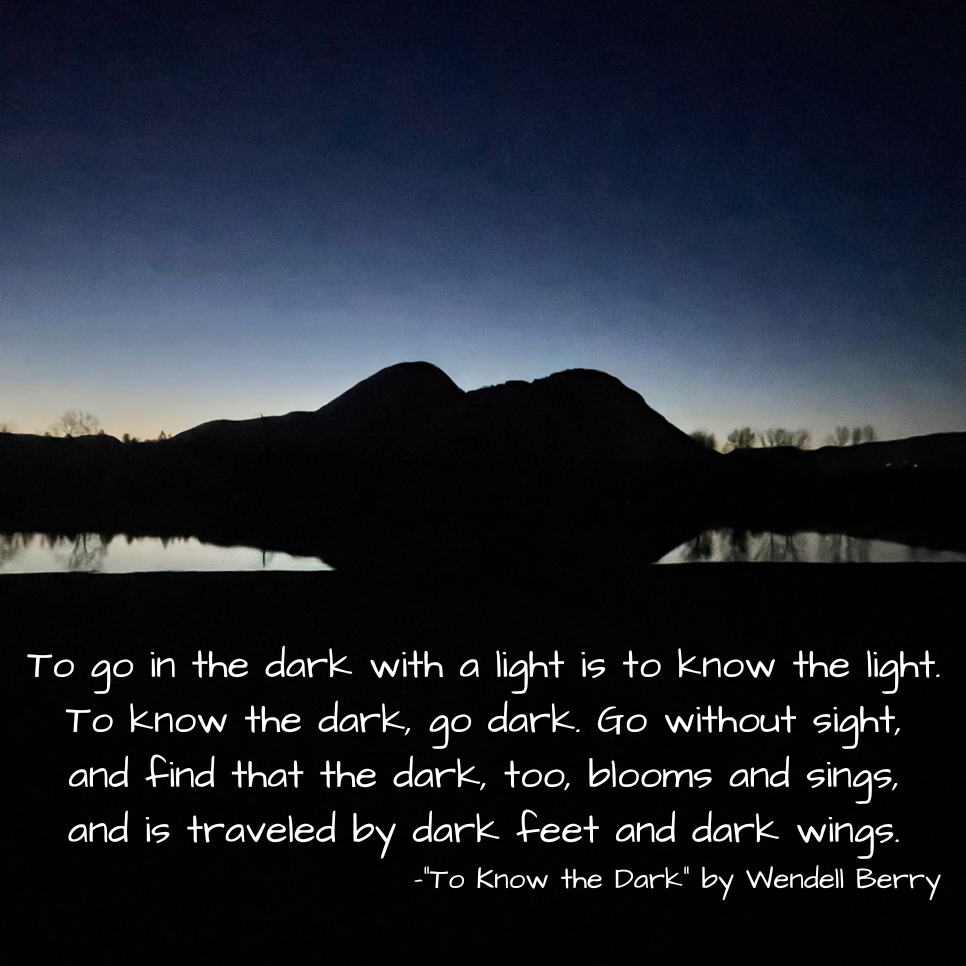
photo by Michele Walker
Winter is here. The cold deepens each day, puddles laced with ice, frost tracing the way down the mountains and stretching toward the valley floor. Even as the chill settles in, I live with the privilege of a heated home—a place where I can step out of the cold whenever I need to.
What I notice more than the temperature, though, is the darkness. Mornings arrive without light, and night seems to slip in by mid-afternoon. As we move closer to the solstice—the celebration of the longest night—there is a cultural pull to push the dark away: to celebrate the returning light, to cover our homes in Christmas lights that brighten the gloom and make winter feel more cheerful. Darkness becomes a problem to fix, something to resist or banish.
Don’t get me wrong—I love lights that warm my home and brighten my spirit. But I keep wondering: what if darkness isn’t a problem to solve at all? What if darkness is an invitation—an opening into a different way of experiencing the world? What if darkness is calling us into relationship, connection? What if I let myself surrender to the dark?
Five years ago, I heard the poem “You Darkness” by Rainer Maria Rilke, and it offered me a new way of seeing, a new way of feeling into the night.
You Darkness — Rainer Maria Rilke
Translated by David Whyte
You darkness from which I come,
I love you more than all the fires
that fence out the world,
for the fire makes a circle
for everyone
so that no one sees you anymore.
But darkness holds it all:
the shape and the flame,
the animal and myself,
how it holds them,
all powers, all sight —
and it is possible: its great strength
is breaking into my body.
I have faith in the night.
Hearing the line “darkness holds it all” stunned me. Growing up, darkness was taught as something frightening and unsafe—a place where the boogeyman hid, where nightmares lived, where danger lurked. Those stories overshadowed everything else: that you need darkness to see the stars; that moonflowers bloom only at night; that the swooping flight of bats depends on the cover of dusk.
So I ask: what if darkness carries wisdom and gifts for you? What if darkness is a place of nourishment? What if darkness wants to hold you the way soil holds a seed—nestled, quiet, resting, preparing for the next season of growth? What if Darkness is sacred?
Something For Your Heart
Sweet Darkness
by David Whyte
When your eyes are tired
the world is tired also.
When your vision has gone,
no part of the world can find you.
Time to go into the dark
where the night has eyes
to recognize its own.
There you can be sure
you are not beyond love.
The dark will be your home
tonight.
The night will give you a horizon
further than you can see.
You must learn one thing.
The world was made to be free in.
Give up all the other worlds
except the one to which you belong.
Sometimes it takes darkness and the sweet
confinement of your aloneness
to learn
anything or anyone
that does not bring you alive
is too small for you.
A Sacred Practice: Ritual for Befriending the Darkness
To shift from resisting darkness to entering into relationship with darkness—welcoming their presence as teacher, witness, and companion. Choose a time when night has fully arrived. Turn off electric lights or dim them as low as possible.
Cross the Threshold
Dim the lights. Take three slow breaths.
Whisper: “I enter the night with openness.”
Greet the Dark
Sit in near-darkness. Let your eyes soften.
Ask silently: “How do you want to be known?”
Offer Something to Be Held
Open your palms. Name one fear, hope, or unfinished story.
Say: “Hold this with me.”
Listen with the Body
Notice sensations—warmth, stillness, tightening, spaciousness.
Let darkness be a presence, not an absence.
Receive What Comes
A feeling, a quiet moment, or nothing at all.
Whisper: “Thank you for what you hold.”
Return with Intention
Light a small candle.
Say: “I walk with the night, even in the light.”
Take some time to reflect on what you heard and were offered. consider creating art, write a poem or move your body to capture your experience.